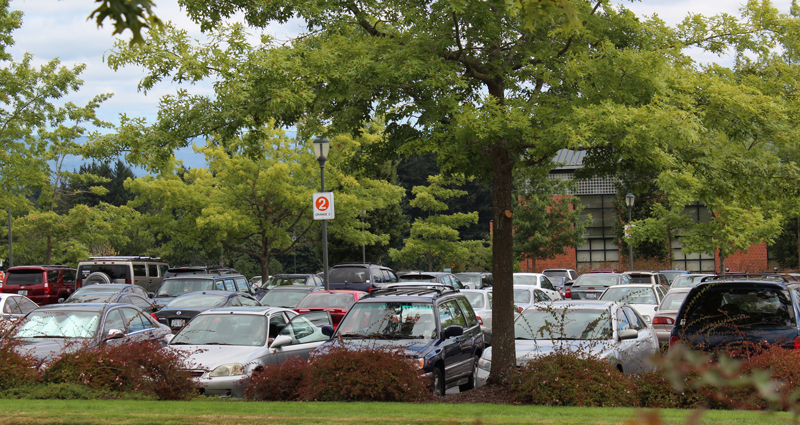
Visitor parking
Plan Your Visit: Parking at WSU Vancouver
Welcome to WSU Vancouver. Whether you are visiting campus for a tour, a community event, or a meeting, we provide several short-term parking options to make your arrival seamless. WSU Vancouver utilizes modern parking technology to ensure that finding and paying for a space is quick and efficient.
Payment for parking is required from 7 a.m. to 7 p.m. Monday through Friday, year-round. Outside of these hours and all day on weekends, parking is complimentary. All parking on campus is governed by the Washington Administrative Codes.
Metered Parking
Convenient for quick stops or short meetings, meters are located throughout campus.
- Free 30-Minute Parking: Available near the Dengerink Administration Building and Student Services Center. Scan the signpost QR code and input your vehicle license plate to start your free 30-minute parking session.
- Two-Hour Metered Spaces: These spaces utilize AIMS Pay-by-Plate. For hourly parking, simply scan the QR code located on-site.

Daily and Hourly Options
WSU Vancouver utilizes AIMS Pay-by-Plate for the most convenient way to park on campus. Scan the QR code below to get started! If you do not want to download a smartphone app, you may also pay via the AMP website.
Alternatively, you can also pay for a daily virtual permit over-the-counter from the Parking Services office located at the Central Physical Plant Building and is open Monday – Friday from 7:30AM – 5:00PM.
To see a list of all available daily or metered areas on campus, search “WSU” in the location bar in the app or AMP website.
License Plate Recognition (LPR) Program
The following sections outline the Washington State University Vancouver Campus policies regarding the use of vehicle license plate recognition (LPR) hardware and software. This technology connects campus parking permits to individual vehicle license plates to enhance enforcement and improve the customer experience.
Washington State University Vancouver Campus. Washington State University (WSU) utilizes vehicle license plate recognition (LPR) hardware and software for its parking system. LPR and pay-by-plate technology specifically connects campus-parking permits to individual vehicle license plates. These technology improvements significantly enhance and simplify the customer experience, enforcement, and parking lot utilization analysis.
LPR data is collected on the WSU Vancouver campus streets, parking lots and parking areas, and other areas that WSU is or may become responsible for (see Campus Parking Map here). LPR data is collected by cameras positioned on a mobile vehicle-mounted system. Any “LPR vehicle” is driven by trained personnel in parking locations throughout the WSU Vancouver campus. LPR vehicles can be active 24 hours daily, 7 days per week.
The LPR system captures two photos of observed vehicles: (1) a context photo of the vehicle and its immediate surroundings and (2) a photo of the license plate. Typically, these photos are taken from the rear of the vehicle, although there are occasions where a photo is taken from the front (e.g. when a car is backed into a parking space). The photos are not of a resolution that allows identification of the vehicle occupants. Along with the photographic data, the system also records the Global Positioning System (GPS) coordinates and date/time information of the observation. Further software processing of the vehicle license plate image generates an alphanumeric version of the vehicle license plate number which is also stored with the parking LPR record.
The intended use of data collected by the LPR system is for parking activities and enforcement. LPR data is used to determine a vehicle’s parking permit permissions in a given parking area and support the issuance of a parking citation if needed. The data may be used by the WSU Police Department in assisting immediate or on-going safety concerns and conducting specific security investigations; and compulsory law enforcement investigations. Any use of the data for purposes outside of these stated purposes must be detailed and approved in writing through administrative channels by the Vice Chancellor of Finance and Operations.
Data collected by the LPR system not resulting in parking enforcement action or not part of an ongoing law enforcement investigation may be retained up to 90 days. Statistical lot utilization data (generic vehicle counts) is retained indefinitely for parking program planning and operations. Data resulting in parking enforcement action is retained with the citation (ticket) records according to established WSU data retention policies. Data associated with an ongoing security and/or law enforcement investigation is retained until the investigation is completed or as directed by investigators or courts and/or in conformance with WSU data retention policies.
Access to records created and maintained by the LPR system is restricted to trained WSU Public Safety and Parking personnel performing their duties and WSU Police Department law enforcement personnel. All personnel with access to the system use unique identifiers and passwords to access records and all login, record additions, and other activity is logged. Access to the system by others is prohibited. Note that data may be subject to the Washington Public Records Act and subject to legally recognized redaction.
Students, faculty and staff with a WSU parking account may view information we have about their own individual vehicles at any time by logging onto their parking account.
WSU will notify the public of its LPR data collection activities and policies via: Posting of this privacy policy on the WSU Vancouver Parking Services website. For additional questions regarding LPR, please email parkingservices@wsu.edu.
Access or Update your Parking Profile
Starting fall 2025, your vehicle license plate will serve as your parking permit. Maximum of two license plates per permit, and only one vehicle is allowed on campus at any given time.
Contact Us
Fall Semester Hours
- Mon – Fri: 7:30am – 5:00pm
Besides parking maintenance and traffic management, parking fees pay for extra security patrol, AED maintenance, area lighting, door unlocks and jump starts, flag replacement, lost and found, and more.