How DTC students built a fantasy video game in 16 weeks
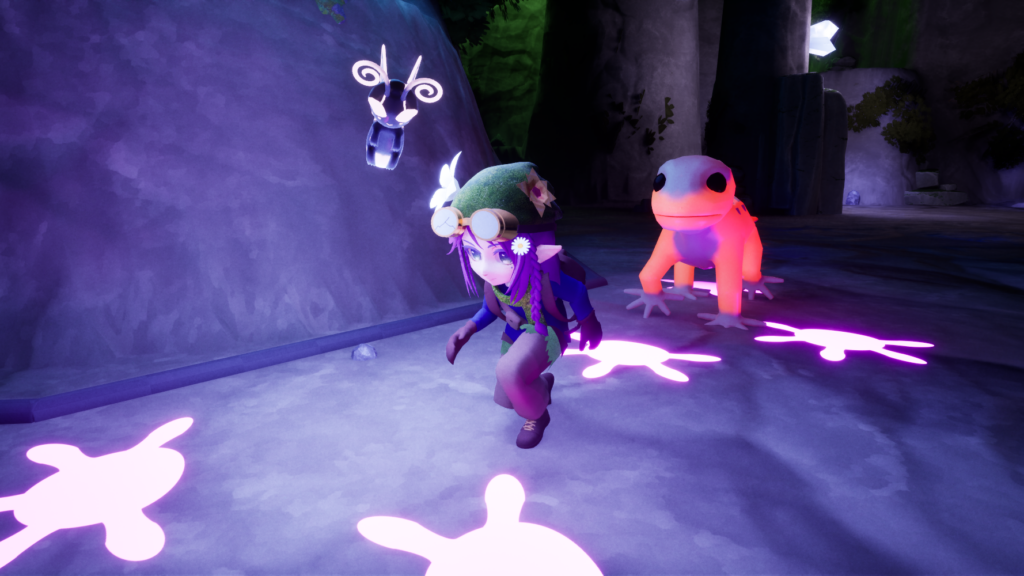
Fantasy character sneaking through a cave while a glowing gecko creature follows behind.
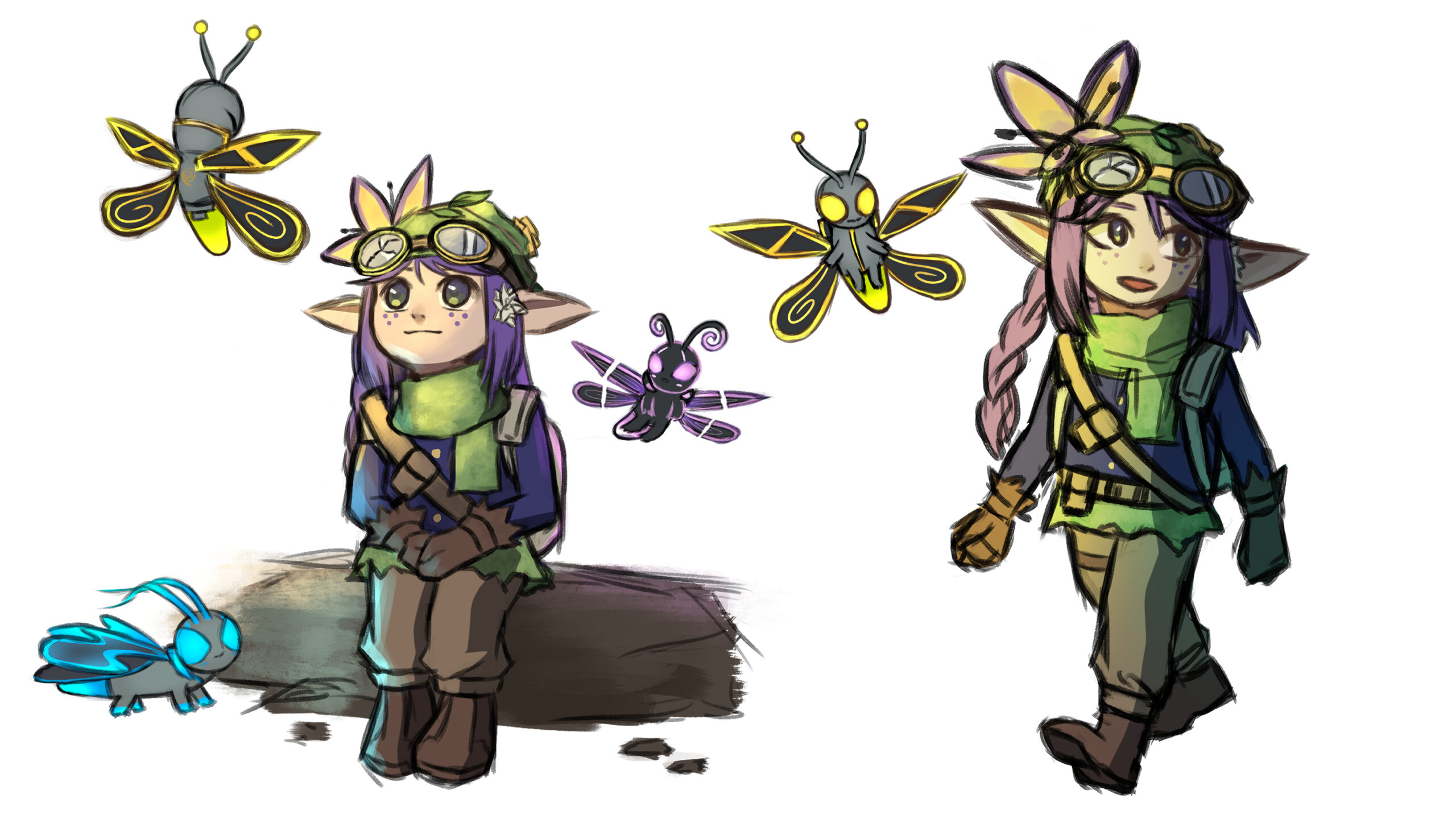
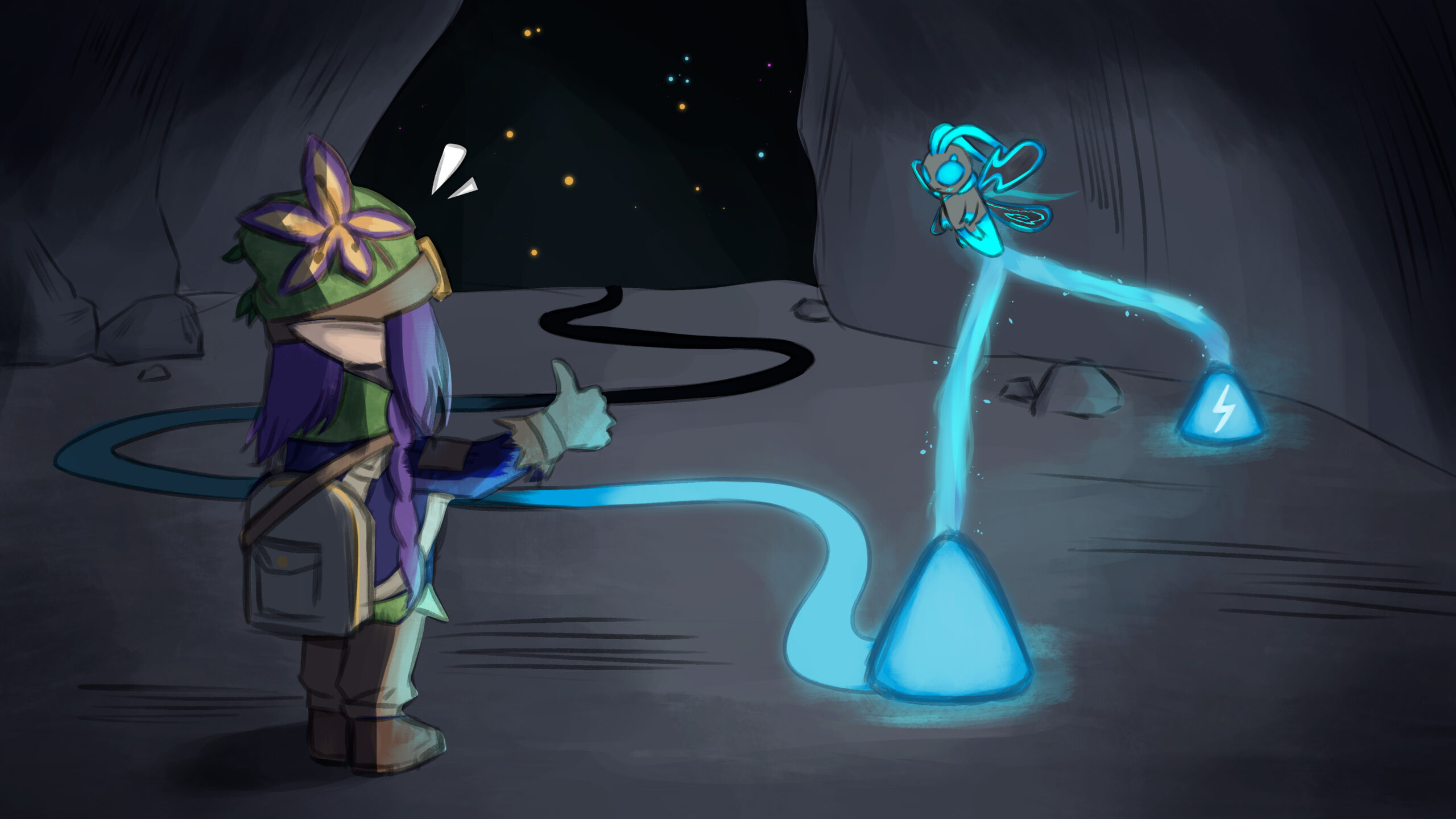
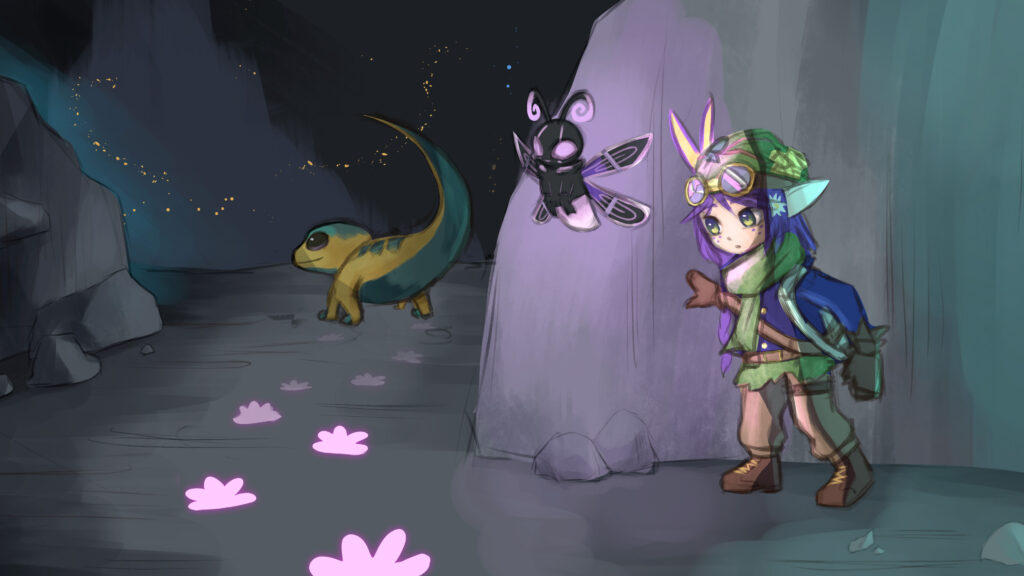
In a faraway underground kingdom, a young girl named Scout sets forth on a daring adventure. As she seeks out the scattered fragments of a sacred artifact that will save her village from calamity, she must also watch out for prowling geckos and tunneling moles — no easy task, considering she belongs to a race of two-inch-tall elflike creatures.
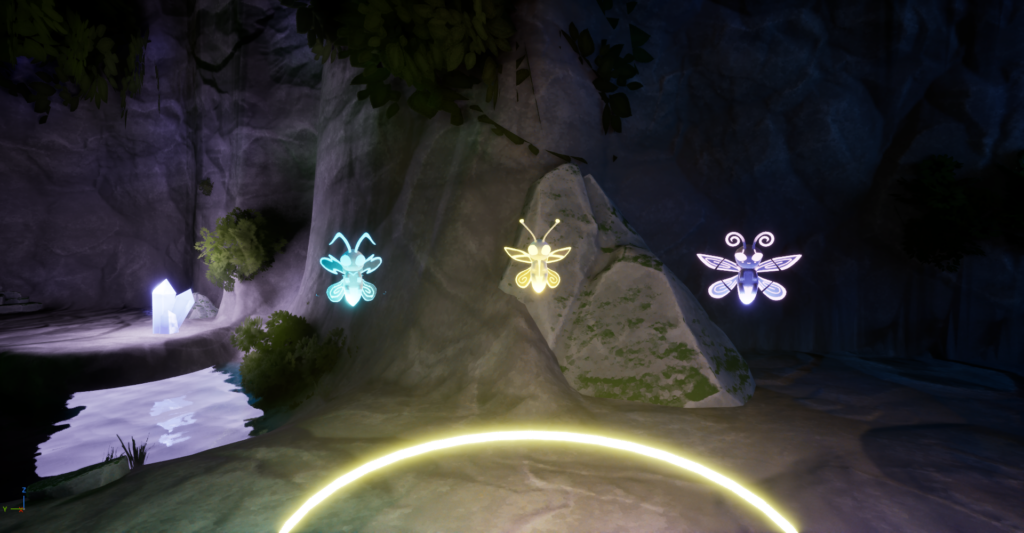
Fortunately, she’s not alone. With the help of three firefly companions who grant her special abilities, she can stun enemies with light, grapple onto objects, and reveal hidden secrets in the environment.
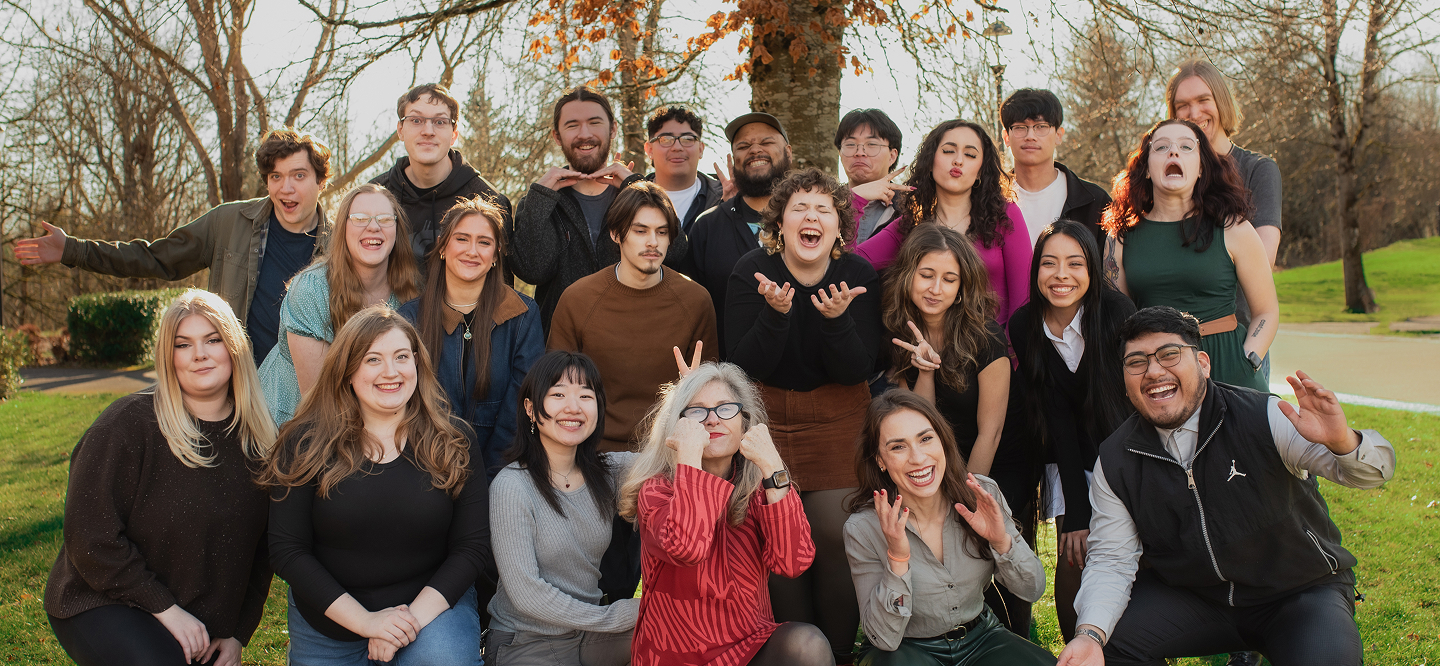
Such is the premise of Fireflies, a fantasy video game developed in Unreal Engine 5 by a group of 21 graduating seniors from Washington State University Vancouver’s digital technology and culture (DTC) program last semester.
“It’s a puzzle-stealth adventure game,” said Tristan Mattole, who served as the game development lead on the project.
The game was created as part of the DTC senior seminar, a course taught by Professor Dene Grigar that sees students working together on a collaborative digital media project under the guidance and direction of an industry client.
“It’s like the finishing school boot camp that polishes them up before they go out into the field,” Grigar said.
For the spring 2026 cohort, students partnered with Noctua Interactive, a Vancouver-based indie game studio, and its CEO and founder Nathan Stahlman. Specifically, the team was tasked with creating a “vertical slice” for an original game aimed at exploring the creative and marketing potential for one of the studio’s intellectual properties. Like a demo, a vertical slice refers to a short, playable game that serves as proof of concept for a larger, full-fledged experience.
“In this case, we had a bank of four fresh IPs that are on our roadmap to test and validate,” Stahlman said. “We let the students pick which of those had greater interest to them, as passion on a project frequently creates an interest that wouldn’t happen otherwise. The team chose Fireflies from our ready IPs.”
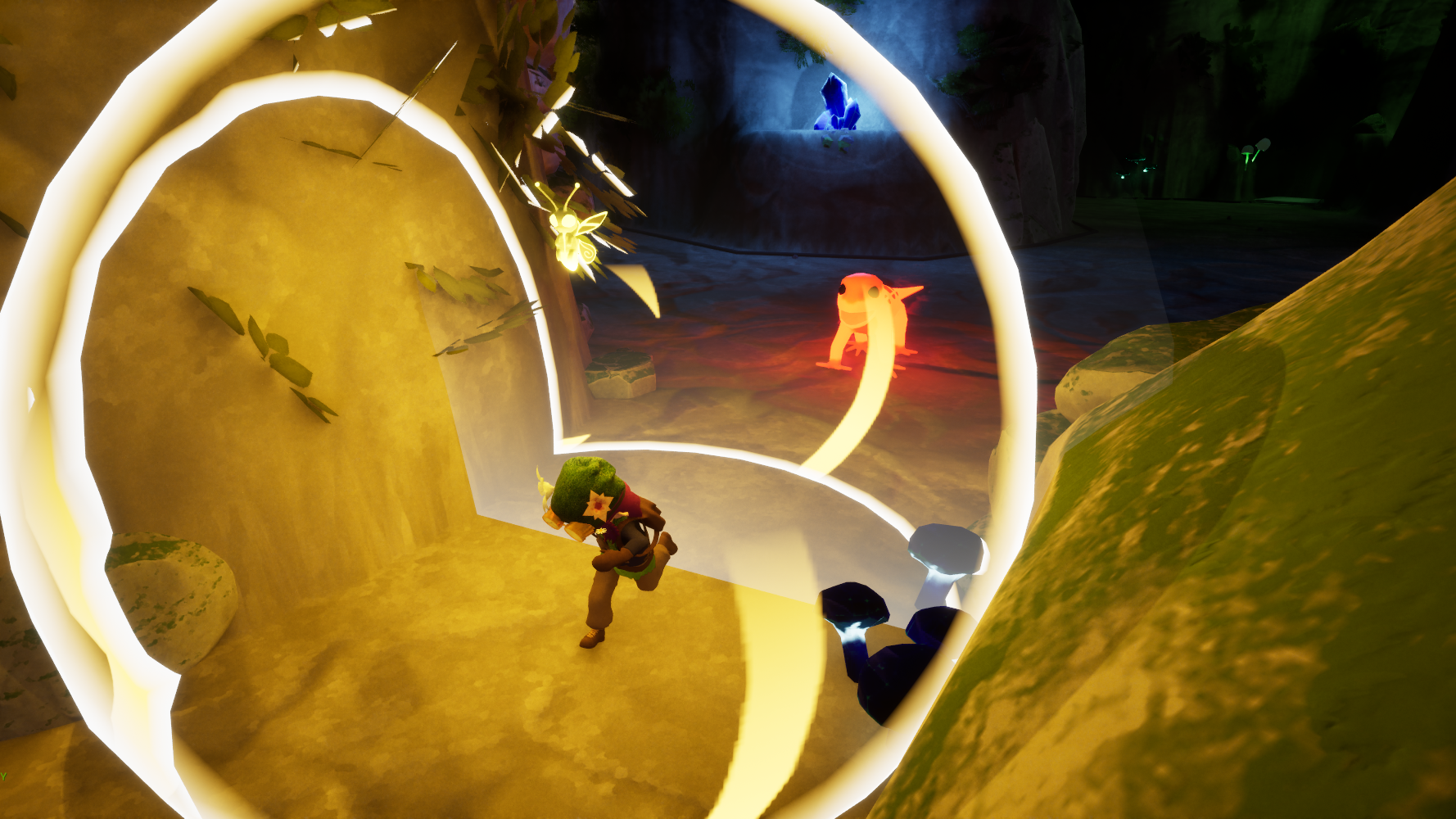
In the team’s version of the game, players guide Scout through an open, cavernous environment filled with giant luminous mushrooms, crystals, and moss-covered rocky surfaces. The objective is to find and gain entrance to a locked room containing an artifact piece — all while avoiding the enemy moles and geckos. Mattole said the slice represents what a mid-game level might look like.
“If you know what you’re doing, it takes about five minutes,” Mattole said, noting that for newcomers, playtime might extend to roughly half an hour. “We wanted the player to feel like they were exploring and discovering things.”
In addition to the game itself, students also created a trove of marketing and promotional materials, including a website, social media campaign, game trailer, and documentary series — all in the span of just 16 weeks.
“A lot of people underestimate how long it takes to make games,” Mattole said. “And we made a really impressive vertical slice in a very short amount of time.”
Some assembly required
To understand how the game came about, it helps to know how the DTC senior seminar operates. Because the course is built around an intensive, client-driven project that changes each semester, it requires weeks and sometimes months of pre-semester planning and prep work. For Grigar, that process invariably begins with each student responding to a personal survey question: What’s your superpower?
It’s not an ice breaker, and it’s not really about superhuman abilities, à la Marvel’s Avengers — although she is assembling a team. Practically speaking, it’s another way for Grigar to gauge each student’s professional talents and interests.
“For example, a student might say, ‘I want to be a 3D modeler when I graduate,’” Grigar says. “That’s their superpower.”
From there, Grigar scours her network of business and community contacts for a client she can match to her students’ inventory of skills.
“Once I have the team, then I go out and find the project,” Grigar says, “because it has to fit their needs.”
Since launching the course in 2007, Grigar’s seminar students have created everything from custom websites and mobile apps to interactive experiences using augmented and virtual reality technology, as well as modern restorations of classic computer games.
With the client and project deliverables identified, Grigar’s next task is to identify and select a handful of students to serve as team leads. Students interested in lead roles go through a standard interview process with a faculty-led panel.
For the making of Fireflies, work was split among six separate teams comprising 3D modeling, design, game development, motion graphics, social media, and web development — as well as a separate executive team consisting mostly of support faculty.
Drawing the roadmap
Before a single character sketch was committed to paper or a programing command was executed, Grigar’s students had to first decide what kind of game they were going to make.
“We put in a bunch of work on making a design document,” Mattole said. “We probably remade it a thousand times.”
Although the client had provided some details about the game’s world and scenario — including the central premise of the tiny, earth-dwelling creatures known as the Nells — it was left to the team to develop a set of core mechanics that would best tell the story.
There was also a matter of learning new tools for the first time. Whereas Mattole and Waite had previously collaborated on an extracurricular real-time strategy game in the Unity game engine, this was their first attempt at using Unreal.
“We ran into a lot of issues specifically with lighting in Unreal,” Waite said.
Since the universe of Fireflies takes place underground, Waite says, the team had to come up with clever ideas for how to light the space in a way that felt authentic. That led to the team incorporating in-game objects like bioluminescent mushrooms and crystals, but it also led to hours of painstaking tweaks and troubleshooting.
“It turns out that when you’re working in a 3D game engine, coming up with that kind of dim underground lighting can be really tricky,” Waite said. “We had to mess with a lot of things to get the lighting to actually look good and be usable from a gameplay perspective.”
Growth management
While every student had their own hurdles to surmount, perhaps no one had quite as many problems to solve as Quid Melton. As the overall project manager, they had more than just a few pie pieces to worry about. Their job was to make sure the entire project came together on time, according to the client’s wishes.
“There was a time that we were looking at it, and I thought, ‘I’m not sure if we’re going to be able to get this done,’” Melton recalled.
Looking back, Melton admits to feeling a bit of imposter syndrome at the beginning of the project.

“I was like, ‘Oh, shoot. All these people are so amazing. Why should they listen to me?’” Melton said.
The change happened, Melton says, through a gradual shift in mindset. Instead of merely assigning tasks and deadlines, Melton reframed the manager role as one built more around the act of listening and responding to the needs of the team.
“I figured my job was to make people as comfortable as possible, relieve stress, and get them the information that they needed,” Melton said. “If nobody wants to ask the professor a hard question, I will do that. And I’ll talk to the client so that my team can do what they need to do without having to stop and worry.”
At times, Melton says, being project manager meant taking midnight calls from a stressed-out team lead and coming up with a plan for the next day.
“Most of the time, people leaned on me to coordinate and also just be the decision maker,” Melton said.
Story in motion
As the team lead for motion graphics, Sasha Gonzalez helped oversee two major deliverables for the project. The first was a behind-the-scenes documentary series that follows the story of the game’s development. The second was a teaser trailer that would be used to help sell the vision for the game.
Gonzalez personally took the lead in building the Fireflies trailer, blending slices of in-game footage with animated clips made from generative artificial intelligence. For the latter, Gonzalez relied heavily on the huge volume of concept art created by design team member Brent Ocampo. Even with so much material to work with, getting the right results took effort.
“I’m sure you’ve seen AI videos that look really poor and sloppy, and that’s just somebody using one prompt where they give it an image, tell it to do something, and they’re done with it,” Gonzalez said. “I went through hundreds of iterations of AI video generations to try to make that thing look exactly how I wanted.”
While AI-generated animation isn’t a replacement for traditional hand-drawn techniques, Gonzalez says, it’s becoming a helpful tool for all kinds of creative teams — noting that Noctua Interactive is a strong proponent of using AI to iterate on ideas more quickly.
“You’re saving a lot of time,” she said.
For the documentary, Gonzalez’ team captured extensive amounts of B-roll footage and interviews with team members at various stages of development. They then edited and released five short episodes at regular intervals, concluding with the final presentation in May.
“We really cared about portraying the struggles and remembering, ‘Oh, yeah, that happened and this happened,’” Gonzalez said. “I love seeing the reactions when people watch the documentary and the teaser trailer. You really want to make something, when you’re a video person, that resonates with people.”
Above and beyond
In the end, the Fireflies team managed to exceed the client’s initial expectations, particularly in the areas of art and animation. Because the students would be crunched for time, Stahlman had initially suggested the team stick to “grey boxing” — a term for using colorless placeholder boxes and shapes instead of polished 3D art assets — for the playable build of the game.
But when the first few weeks of hands-on production saw the team ahead of schedule, they saw it as an opportunity to shine. That’s when three students, each with limited experience in 3D modeling, took on the additional role of creating in-game character, enemy, and environment art assets.
“When we first were making the video game, we weren’t sure how everybody would work together,” Melton said. “We didn’t realize just how amazing everybody was.”
The team even received an assist from 2024 DTC alumnus Andrew Truax, who volunteered his time as an additional artist and consultant.
“He made so many models and so many animations, and it was amazing,” Melton said. “That’s one of the things that’s really fun about senior seminar is that it’s not just one professor. You’ve got a whole bunch of alumni and other faculty coming in.”
For Waite, who doesn’t consider himself a visual artist, getting to interact with the other disciplines was the best part of the experience. In that way, he says, it felt like an authentic game studio project.
“To be able to program the logic for the gecko and then later on have an actual model that was handmade and hand-textured and animated — and just see what was a default mannequin walking around become a real in-game asset that I programmed — was really satisfying,” Waite said. “It’s super rewarding to be able to combine those skills and make something awesome.”
When asked about the final product, Stahlman said the team’s visual and game design adaptation succeeded in demonstrating a future path for the Fireflies property.
“With the short time available they were able to create multiple areas of interest that allowed us to evaluate the potential of the IP and the interest shown by the team,” Stahlman said. “I enjoyed seeing the final product and the process by which they created it.”
As with Scout and her firefly friends, Melton said the DTC team finished strong not because of any single superpower.
“It wasn’t just one person that went above and beyond,” Melton said. “Everybody went above and beyond.”