
From Labs to Industry
Labs
ENCS operates several state-of-the-art laboratories devoted to teaching and research. The labs in the Computer Science and Engineering Building were built and equipped expressly for our computer science and electrical engineering programs.
- Two computer science teaching laboratories
- Two open computer laboratories with the same capabilities as the teaching laboratory machines
- Digital systems laboratory
- Electronics laboratory
- Radio-frequency teaching laboratory
- Power systems laboratory
- Cleanroom laboratory, including a Class 100 cleanroom
- Automation laboratory
- Computer-aided design laboratory
- Computer-aided engineering laboratory
- Device diagnostics and microelectronics laboratory
- Manufacturing laboratory
- Materials laboratory
- Robotics laboratory
- Thermo/fluids laboratory
ETAP software
ETAP is a power system simulation software suite that contains a group of sub-programs that handle a variety of power system analysis. The analysis types include balanced and unbalanced load flow analysis, short circuit analysis, arc flash analysis, real-time simulation, distribution system design, grounding, protection scheme simulations, and others. The software is used mostly by engineers at the facility design and control levels, and includes energy management modules and substation automation.
INDUSTRY PROJECTS
At WSU Vancouver, students bridge the gap between classroom theory and professional practice through collaborative industry projects. These partnerships allow students to tackle authentic technical challenges alongside regional firms, gaining hands-on experience in design constraints, safety protocols, and prototype testing. Many of these capstone initiatives lead to the development of commercial products, preparing graduates for successful careers in high-demand technical fields.
Working in small teams, students navigate the full lifecycle of a project from conceptualization to analysis. These experiences often involve building physical prototypes or complex software architectures that improve operational efficiency and safety for our partners. By engaging with industry leaders, WSU Vancouver students refine their skills in hardware design, machine learning, and systems integration.
For Columbia Machine, a team of four students designed and built a prototype of an electric end effector to be mounted to a gantry system and able to manipulate different size boxes of products traveling on a conveyor system.
WaferTech specializes in the production of silicon wafers. Many hazardous materials are used in the process and safe disposal is a necessity. To improve safety, WaferTech requested a semi-automated plate cleaning system requiring no human interaction. Students came up with a design that incorporates the use of a winch to move a cleaning head assembly along the surface of the separated filter plates, reducing labor costs as well as improving safety.
The StingRay MPS design project is a simple magnetic position system designed to easily integrate into computer technologies. The design uses two magnetic beacons to generate two discrete magnetic fields. Integrated with a microcontroller, the device can generate a pattern of signals, analyze the resulting sensor output and transmit the information necessary to identify the position of the sensor. This system provides an affordable alternative to current technologies and can be modified to fit multiple applications. The project was one of two top chosen projects in the U.S. and went on to take 3rd place at the international competition in China.
Logitech requested an air leak detector to detect leaks within speakers. The students’ design is based on the pressure versus volume change. If a leak is detected, the volume should be slightly different compared with a “good” batch of speakers. It would be simple for people using the detector to pass or reject the speaker.
US Digital produces optical encoder modules for rotary and linear motion sensing. An optical rotary encoder outputs signals when a code-wheel is rotated past the sensor. In this project, students worked with US Digital engineers to develop a hardware element capable of monitoring and measuring the timing parameters and implement it into current USB4 device by designing a FPGA coding scheme.
Intel wanted students to design an energy-efficient motion estimator for video applications. The objective was to reduce the size of transmitted video while maintaining high video quality. Students researched and implemented a video encoder using motion estimation into MATLAB software and Verilog hardware description language.
This project designed and produced a front control panel for a new laser system produced by nLight. The tasks included panel and PCB layout, circuit simulation, electronics components selection and firmware design.
Power ride through device (RTD) is a critical tool to protect equipment used by WaferTech for IC fabrication from power sag and outage. In this project, electrical engineering students analyzed RTD in collaboration with WaferTech engineers. A testing circuit was built with performance of the output power from the device during the loss of single and multiple phases of the input power under different circumstances fully characterized.
Sharp Laboratories of America (SLA) is the U.S. research and development (R&D) subsidiary for Sharp Corporation of Japan. In this project, a team of five students built a virtual world generator using the Unity game engine. Based on a set of environmental parameters, such as weather, season, scene, etc., this tool automatically generates a synthetic reality, which can be used to train machine learning algorithms to identify objects under different conditions.
The United States Geological Survey (USGS) serves the Nation by providing reliable scientific information to describe and understand the Earth, minimize loss from natural disasters, and enhance and protect the quality of life. A team of 5 students designed a web-based volcano alert system which monitors the data streams collected by the sensors USGS deployed on the volcanoes in the region. The system automatically generates alerts if potential hazardous events are detected.
South Waterfront Community Relations (SWCR) is a non-profit organization which aims to develop and promote community building activities in Portland’s South Waterfront. A team of four students developed an Android app which utilizes OCR technologies to automate the process of tracking street parking density. This app helps SWCR gain a detailed understanding of on-street parking habits of Portland residents.
AgencyRM LLC, based in San Antonio, TX, is a field Marketing Organization which provides innovative services, systems, and contracting to independent Agents and Agencies throughout the United States. A team of five students designed and implemented a mobile app which mirrors the Agent Portal functionalities the company provides via their website.
Capstone Projects
The Capstone (Senior) design experience consists of a year-long project, spread over Fall and Spring semesters.
Projects are developed and sponsored by local companies. Students work in teams to meet the project expectations of the sponsor. The Capstone experience aims to give students an opportunity to bring together all of the coursework in their program of study along with writing and communication skills, to design and implement a sponsored project.
Sponsors help educate the next generation of engineers and computer scientists.
Capstone projects provide students with real-world experience and a chance to learn what to expect as employees. As a sponsor, you will have an opportunity to observe students and interact with them on the project, to potentially hire them after graduation. Capstone also gives your company a way to develop connections with the university and faculty for other future research collaborations. It can be an inexpensive way to get started on some of the exploratory ideas or projects at your company, and to test or further develop those ideas.
For more details on sponsoring a capstone project, contact encs.connections@wsu.edu.
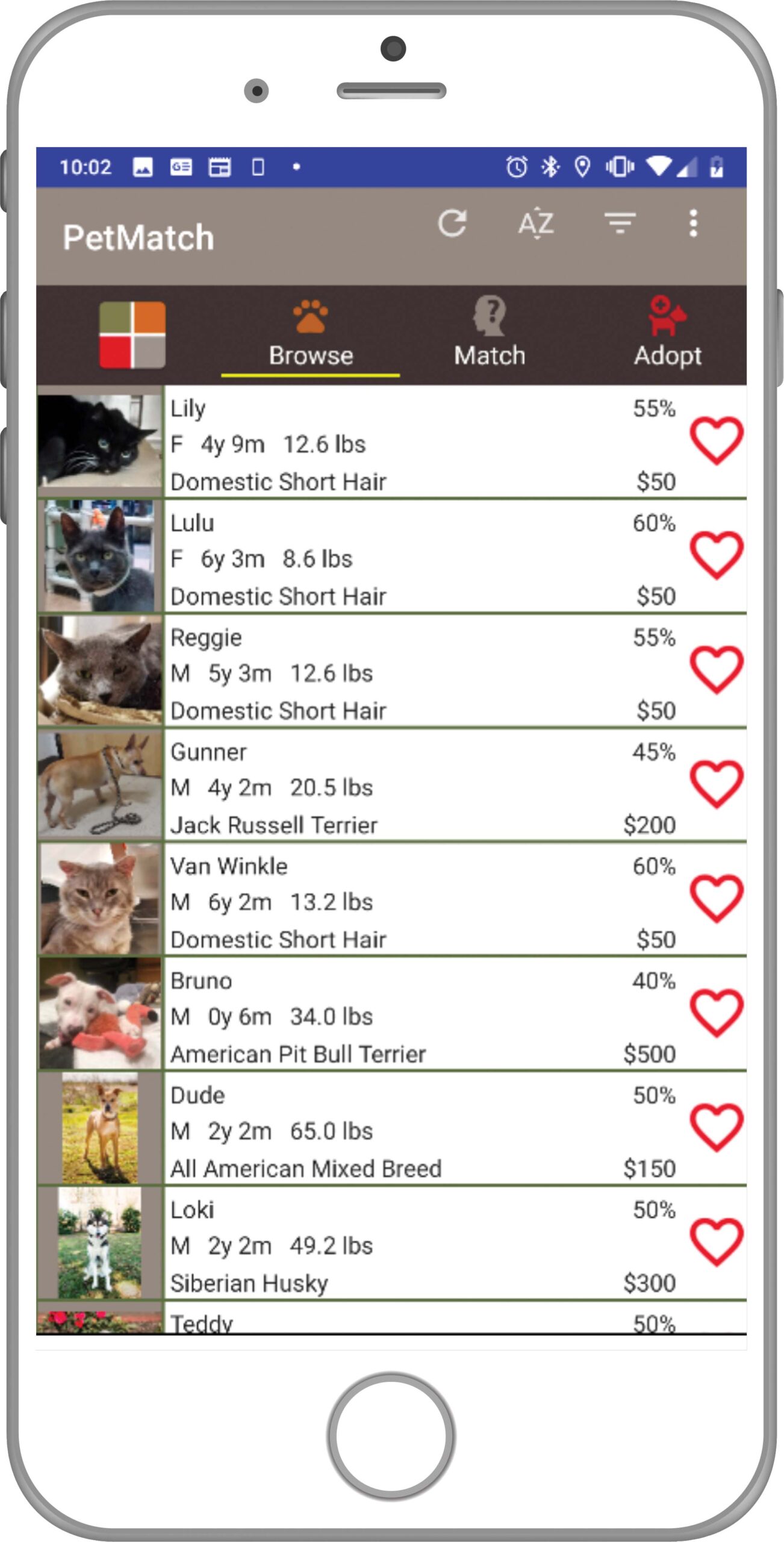
Project examples
- Computer science students created Pet Match (pictured right), a mobile app for pet browsing, matching and adoption, for the Humane Society of SW Washington.
- Mechanical engineering students designed a modular steel pallet rack for transporting and storing a variety of concrete products for Columbia Machine.
- Electrical engineering students designed and built an optical module tester that allowed for quick detection and ease of use in the field for US Digital.
Timeline
Capstone sponsors work with a team of students over the course of an academic year, beginning with the proposal of a suitable project, and concluding with a prototype and presentation of results.
| July – August | Proposals submitted to faculty. |
|---|---|
| September – October | Company presents projects to students; teams assigned; site visit. |
| November – December | Students submit design proposal or software development requirements. |
| January – February | Analysis, design implementation, testing. |
| March – April | Prototype completion, testing, software deployment, reporting, presentation events. |